
SDK Overview
Introduction
Booster Robotics SDK is an integrated development kit for building applications on Booster robots. The SDK uses Fast DDS as its messaging middleware, which is compatible with the DDS communication mechanism used by ROS 2. When message types, topic names, and QoS settings match, ROS 2 nodes and Booster Robotics SDK applications can communicate with the same Booster system services.
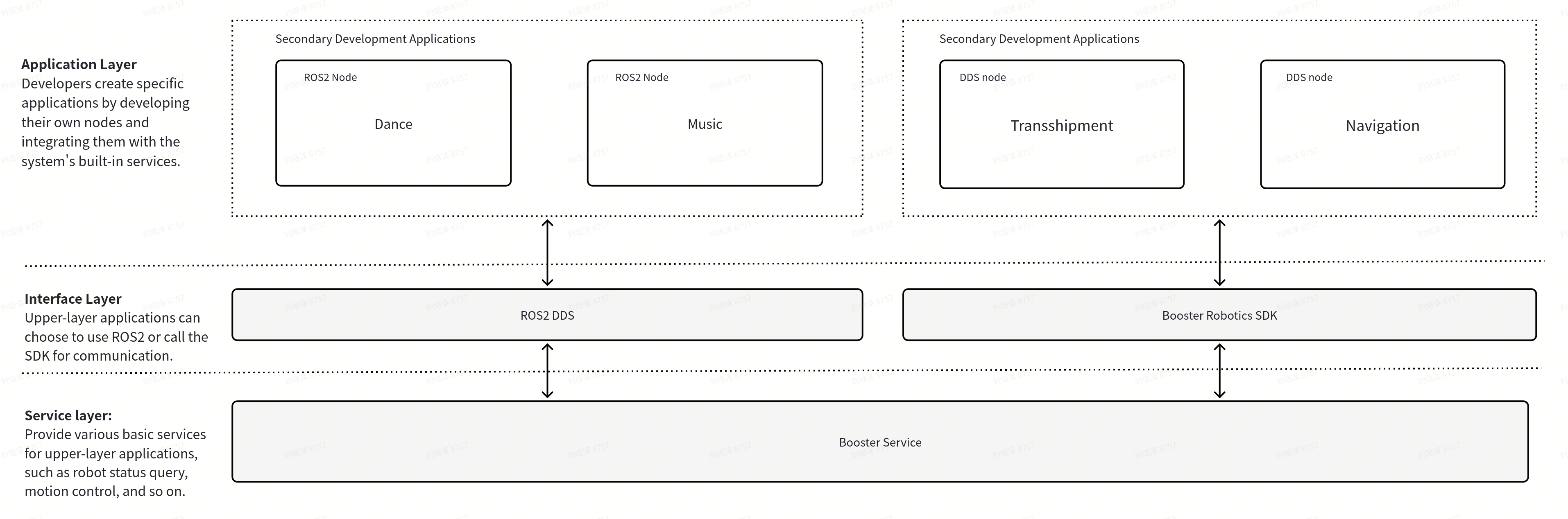
Application, interface, and service layers for Booster robot development
Repositories
- Mainland China Gitee: https://gitee.com/booster_robotics/sdk_release.git
- Overseas GitHub: https://github.com/BoosterRobotics/booster_robotics_sdk.git
Service Overview
The Booster system provides two levels of service:
- High-level services control high-level motion and business capabilities such as mode switching, omnidirectional walking, special actions, head control, vision, and audio. These interfaces invoke the service layer through RPC.
- Low-level services provide real-time sensor data, primarily motor and IMU data, and support direct motor control. These interfaces communicate with the service layer through DDS publish/subscribe.
Documentation Scope
This guide is for C++ developers and describes the SDK release package delivered to users. It is based on the public headers under include/ and the C++ programs under example/.
The documentation is organized around two interface types:
- High-level RPC clients, including
B1LocoClient,AiClient,VisionClient, andAudioManager. - Low-level DDS topics accessed through
ChannelFactory,ChannelPublisher, andChannelSubscriber, includingrt/low_state,rt/joint_ctrl, andrt/odom.
Warning
Low-level control topics can directly affect robot joints and state. Before running an example that publishes control commands, confirm the robot mode, control parameters, and surrounding environment.